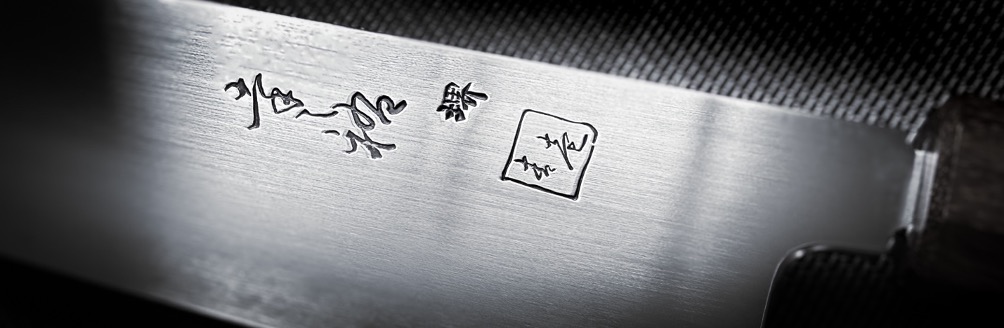
Prologue
Every knife carries a record of its making. Sometimes it is written in steel.
In 2019, forum user Omega published Konosuke Fujiyama; A History on both the Kitchen Knife Forums1 (KKF) and the Chef Knives To Go2 (CKTG) forums. For many collectors, the work marked a turning point. What had previously circulated as rumor, partial recollection, or educated speculation was assembled into a coherent historical account.
Omega traced the emergence of the modern Konosuke company, documented the origins of its first knife—the Fujiyama—and followed the development of later lines including the Togo Reigo and the Fujiyama FM. The work combined narrative with careful visual documentation. Twenty-seven knives were photographed in detail, preserving their profiles, grinds, and—most importantly—their markings.
These markings are more than decoration. They function as identifiers: signatures, production cues, and fragments of a knife’s history.
Since that publication, Konosuke has continued to evolve. New lines have appeared, accompanied by new inscriptions, stamps, and subtle variations in marking practices. As I began collecting Konosuke knives, these markings quickly emerged as one of the most compelling aspects of ownership. Steel and grind determine performance; profile shapes the cutting experience. The markings, however, connect the knife to its origin.
They also introduce complexity.
Knives within the same line may display different kanji. Stamps appear on some examples but not others. Placement shifts. For collectors unable to read Japanese, interpretation becomes more difficult. What first appears straightforward reveals a surprising degree of variation.
Yet the markings possess a quiet aesthetic presence. The kanji are often beautifully rendered—balanced, restrained, deliberate. Kokuin stamps feel purposeful. Even when their meaning is not immediately clear, they carry authority.
This guide grew from that intersection of curiosity and uncertainty. Knives were photographed, examples compared, variations recorded, translations gathered, and questions asked. Gradually, patterns emerged. Some differences proved meaningful; others reflected aesthetic choice or production routine. Over time, the markings began to reveal a language.
What follows is an attempt to share that language.
Purpose of this guide
To understand the marks is to understand the knife.
This guide serves as a reference for collectors and enthusiasts seeking to better understand the markings found on Konosuke knives. It is not a complete catalog of every model produced by the company. Instead, the focus is on blade inscriptions and related identifiers, examining how they function and how they vary across knife lines.
Most examples presented here are gyutos. This reflects both practicality—gyutos are the most widely produced and collected style—and analytical value, as they provide the largest body of comparable material. Within a given line, however, markings generally remain consistent across knife types.
A Fujiyama FM gyuto, for example, will typically share its inscriptions with Fujiyama FM pettys, santokus, chuka bochos, yanagibas, nakiris, debas, and funayuki gyutos. Once understood in one format, the marking system often translates across the line.
Particular attention is given to carbon steel knives and to early, rare, or highly collectible examples. These knives often display the greatest variation in markings. In some cases, the variation reflects production transitions. In others, it reflects individual makers, evolving branding decisions, or subtle shifts in aesthetic preference.
For collectors, these differences provide context.
On your mark…
Every mark carries information. The challenge is learning how to read it.
Throughout this guide, the term markings refers to any inscription, stamp, or symbol applied to a knife to convey information. For Konosuke—as with most Japanese makers—these are primarily rendered in kanji. Kokuin stamps may also appear, either textual or pictorial, and occasionally English words or Latin characters are used.
Understanding markings does not diminish the experience of using a knife; it deepens it. Each inscription becomes more than ornament—it becomes context, indicating lineage, maker, steel, or era. For collectors, that context turns ownership into stewardship.
This guide aims to provide clarity where possible, acknowledge uncertainty where necessary, and encourage careful observation above all.
In addition to blade inscriptions, Konosuke box labels employ a standardized system of English abbreviations that are laid out in a Box Label Companion Guide. (coming soon)
Location
Where a mark appears can matter as much as the mark itself.
One of the first lessons a collector learns is that placement matters.
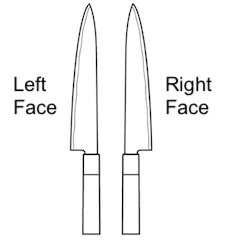
Many markings on Konosuke knives are location-specific, particularly within a given line. The same kanji stamped on the opposite face of the blade can signal a different era, a different production decision, or even a different model entirely. To avoid confusion, I refer consistently to the blade faces as left and right when viewed with the edge down and the tip pointing away from the holder.
Understanding location is often the first step in understanding the knife.
How Marks Are Made
The method used to apply a mark often reveals as much as the mark itself.
Konosuke currently employs three primary methods to apply markings: stamping, chiseling, and laser engraving. Each method leaves a distinct visual and tactile signature, and they occur at different stages of production.
Stamped Marks
Stamped markings, technically called “debossed”3 marks, are generally applied near the end of the forging process. A hardened steel die is positioned on the blade and struck with a hammer, compressing the steel and debossing a recessed impression.
Subsequent grinding, sharpening, and polishing pass across the blade surface, refining the impression and producing marks that appear clean, sharply defined, and mechanically consistent.
Stamped marks sit slightly below the surface, with smooth interior walls and no raised edges.
Chiseled Marks
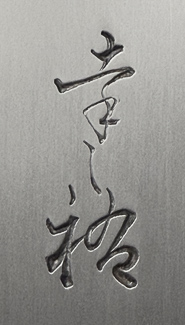
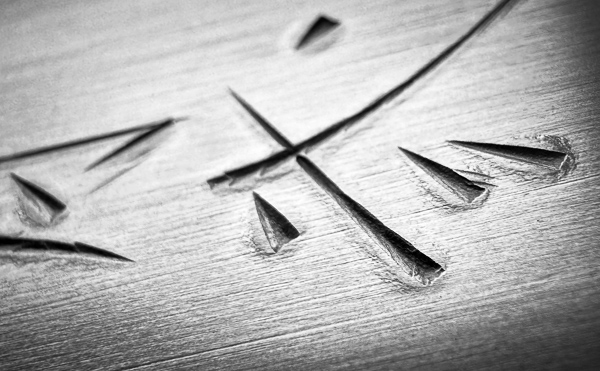
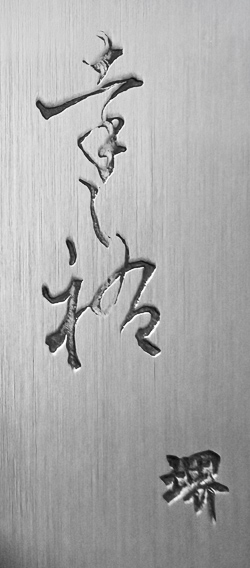
Hand-chiseled kanji possess a distinct character that differs immediately from stamped marks. Applied as one of the final stages of production, after sharpening and polishing, the characters are cut directly into the blade using a hammer and chisel.
Unlike stamping, which compresses the steel, chiseling removes and displaces material, carving narrow slits into the blade surface. This process pushes small ridges of metal upward along the edges of each cut.
These ridges can often be felt when running a finger lightly across the inscription, standing slightly proud of the blade face.
This tactile detail becomes important for collectors. If a knife has been refinished or heavily polished, those ridges are often softened or removed entirely. The kanji will appear smoother and feel flatter to the touch. In this way, chiseled markings can quietly reveal part of a knife’s history.
Laser Engraved
In more recent production, Konosuke has occasionally employed laser engraving for certain markings. This method removes material with a focused beam rather than compressing or splitting the steel.
The resulting marks are precise and uniform, with crisp edges and no surrounding deformation of the metal.
One notable example is the Myojin kokuin used on certain Fujiyama FM Thin Type knives, discussed in greater detail in the Fujiyama FM section.
The Marks
On a Konosuke blade, the markings serve as both identification and record.
The most important and commonly encountered marks are introduced here. Less common examples appear later within the individual knife line sections, where they are examined in the context of specific models.
Konosuke Maker’s Mark
The most significant marking on any Konosuke knife is the maker’s mark, representing the company name in kanji:
幸之祐
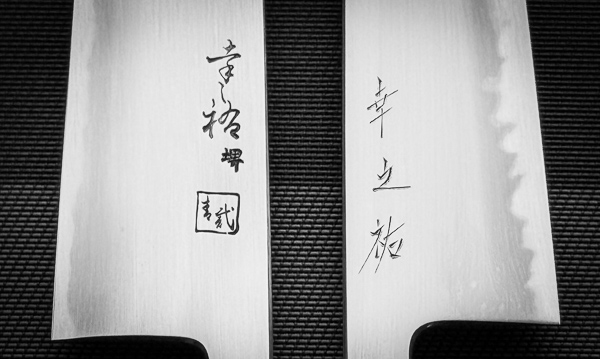
The Konosuke logo is rendered in a style derived from Shodō, the traditional art of Japanese calligraphy. Specifically, it is written in Sōsho, a highly cursive and expressive style characterized by flowing, abbreviated brushstrokes. Sōsho can be difficult to read, even for those trained in Japanese, but its abstraction gives the Konosuke logo its distinctive and iconic form.
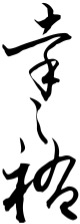
This mark identifies the knife as a Konosuke product. Beyond its literal meaning, it functions as both signature and brand.
Across Konosuke’s knife lines, the maker’s marks vary in form and placement—details that often serve as useful identifiers for collectors. Their configuration reflects factors such as the line and production period.
Sakai Kanji
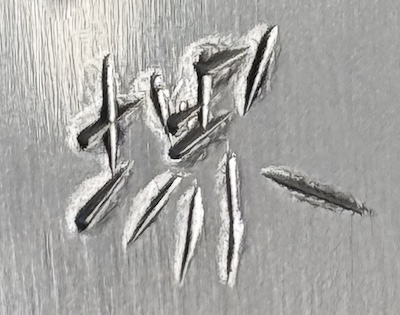
Japanese knife makers use the “Sakai” kanji to signify that a blade was made in Sakai City, Osaka—one of Japan’s most respected cutlery centers, with more than 600 years of bladesmithing tradition.
堺
The mark carries more than geographic meaning. For centuries, Sakai has operated within a highly specialized craft system in which forging, grinding, sharpening, and handle work are often performed by different artisans. The Sakai kanji therefore signals participation in a long-standing regional tradition shaped by generational skill and division of labor.
In many contexts, the stamp functions as a mark of authenticity and origin. For collectors, its presence situates the knife within a specific lineage of place and practice.
Kokuins
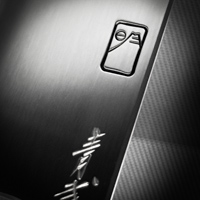
Kokuin (刻印) can be broadly translated as engraving, imprint, or stamp. In practice, Konosuke typically uses the term to refer to boxed stamps, where the mark appears enclosed within a rectangular outline.
Two primary groups of kokuin appear on Konosuke knives.
1. Knife Line and Sharpener Kokuins
At present, two kokuin fall within this category:
- Myojin kokuin used on Fujiyama FM knives
- BY kokuin associated with the BY line
Both marks serve to clarify identity within evolving product lines. The Myojin kokuin identifies the work of a specific sharpener, while the BY mark distinguishes a closely related model family. Each is pictorial in design and is examined in greater detail within the respective knife line sections.
2. Steel Type Kokuins
The earliest Fujiyama knives featured boxed stamps identifying the core steel. These steel kokuins appear most frequently on early examples of the line but are also found intermittently on several other Konosuke knives.
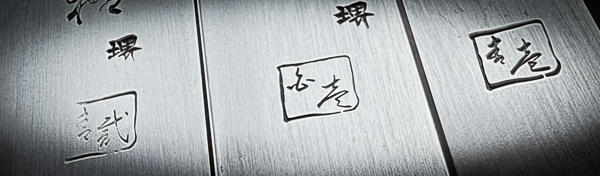
Beyond Steel Kokuins
Steel type on Konosuke knives is not always identified through a boxed kokuin. Over time, the company has employed a variety of markings to indicate core steel, and the resulting variation can be confusing to track. The same steel may appear as a boxed kokuin, as stamped kanji without a border, or as hand-chiseled kanji, each producing a visually distinct result.
Boxed kokuins are typically rendered in Shodō-style calligraphic kanji, giving them a more expressive character. Stamped kanji, by contrast, tend to appear more uniform and mechanically regular, while chiseled inscriptions retain the tactile individuality of hand work, often accompanied by subtle raised ridges along the cut strokes.
As Omega observed:
You may notice, some knives have them (steel Kokuin), and some don’t. The cause
-Omega
for this variance isn’t entirely known- Kosuke has been known to enjoy tinkering
with things across time, and is just one of those examples of subtle variations.
My own research has likewise not revealed a consistent pattern governing when steel kokuins are used in place of other steel markings.
Here are examples of each of the three types of steel markings:
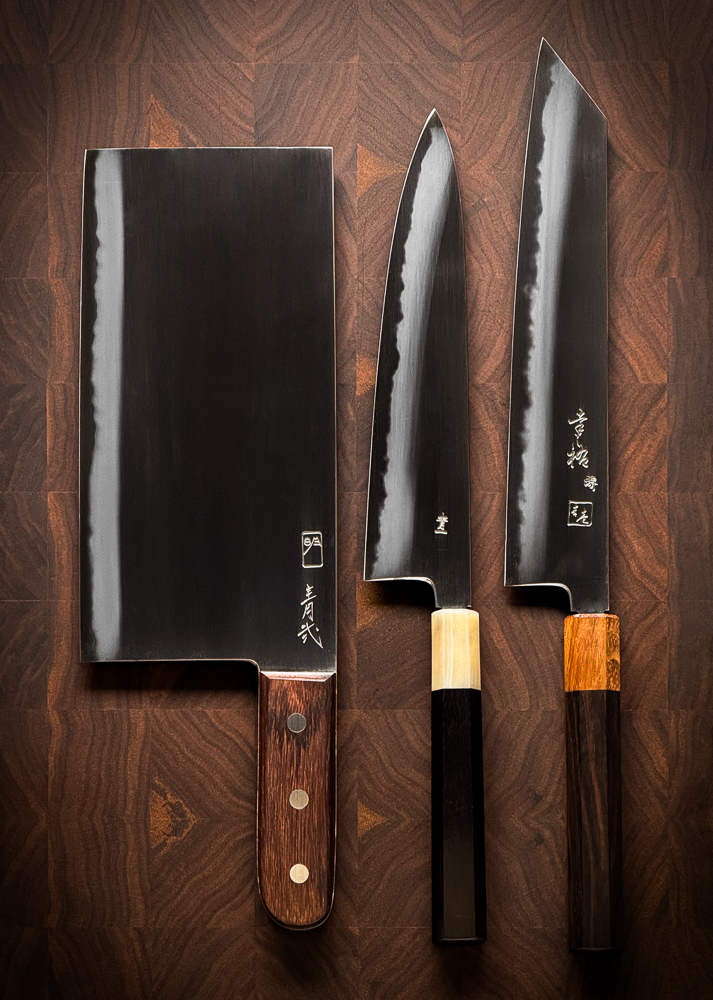
L to R:
Chiseled Kanji (Blue #2) on Fujiyama FM 230 Chuka Bocho circa 2020
Steel Stamp (Blue #1) on Fujiyama FM 210 Gyuto circa 2018
Steel Kokuin (Blue #1) on Fujiyama FM 240 Kiritsuke Gyuto circa 2018
For clarity, the chart below organizes the three primary methods by which Konosuke has indicated steel type. Not every steel has marks in all three forms, and usage varies across knife lines and production periods.
Examples of each mark are shown:
| Core Steel | Stamped Kokuin Shodō Style Kanji | Stamped Kanji | Chiseled Kanji |
| Aogami #1 Blue #1 青壱 or 青一 | 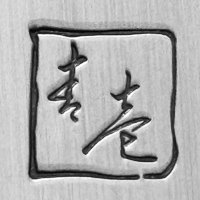 | 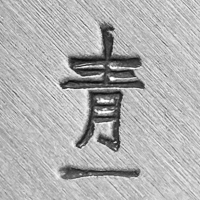 | 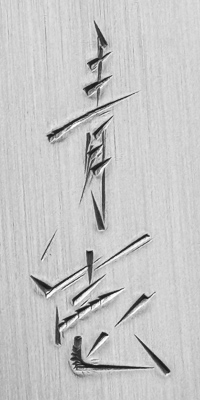 |
| Aogami #2 Blue #2 青弐or青二 | 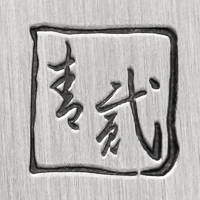 | 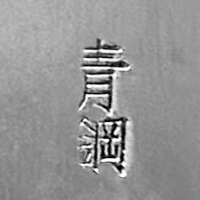 | 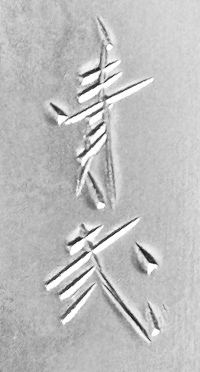 |
| Aogami Super Blue Super 青紙スーパー | 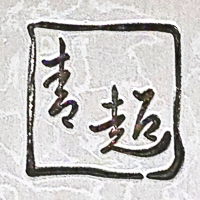 | 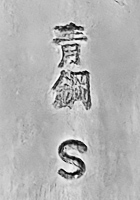 | – |
| Shirogami #1 White #1 白壱or 白一 | 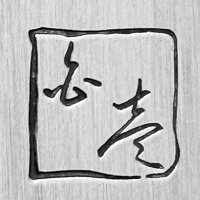 | 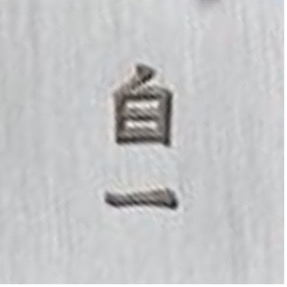 | 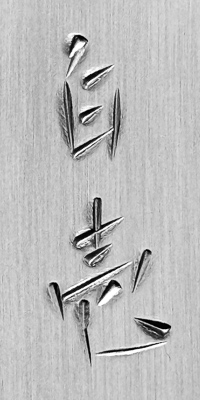 |
| Shirogami #2 White #2 白弐or白二 | Not used? | 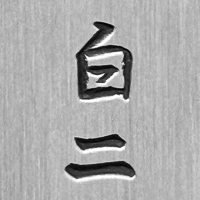 | 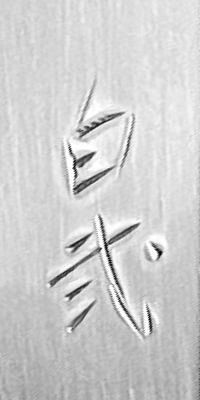 |
| Ginsan Silver 3 銀 | – | 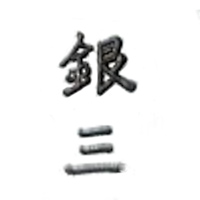 | Not used? |
| SLD Stainless Steel | 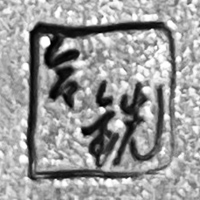 | – | – |
| Vintage Swedish Carbon Steel Togo Reigo | – | – | 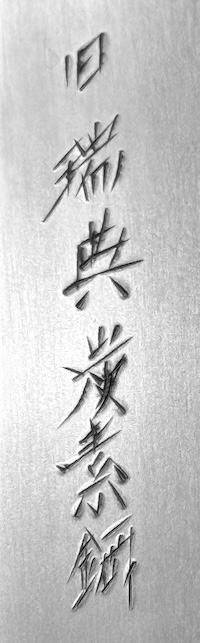 |
Marking Patterns
Despite the variety of markings—and the different positions in which they may appear—Konosuke generally follows a consistent logic in their arrangement across many knife lines. Once recognized, these patterns provide a useful framework for examining and identifying individual knives.
To assist in this process, a Marking Atlas has been compiled for the knives documented in this guide. The atlas organizes the principal marking configurations observed across the examined examples. A typical marking pattern is illustrated as follows:
K-FM-01-NS
Fujiyama FM with Myojin kokuin
In Use: 2020 – present
Left Face: Myojin kokuin, chiseled steel kanji
Right Face: Chiseled Konosuke kanji
Note: No Sakai kanji
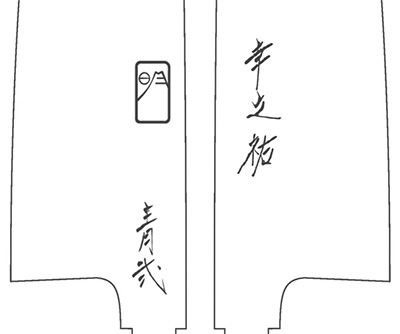
At the beginning of each knife line section, a reference panel presents key information for that line, including the known marking patterns associated with it. These summaries are intended to provide collectors with a quick visual reference before examining the knife line in detail.
| FUJIYAMA Years Made 2007 – 2018 Blacksmith Yoshikazu Tanaka Sharpener Hiromi Morimoto “Morihiro” | Marking Patterns K-F-01 K-F-02 K-F-03 K-F-04 |
Show Me The Knives!
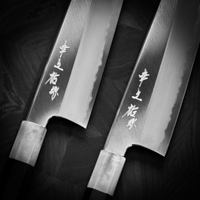
With the above fundamentals established, we can now turn to individual knife lines, examining the distinctive marks and placements that define each.
Select a category below to learn more.
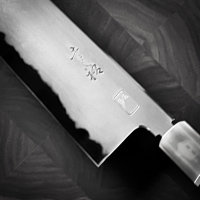

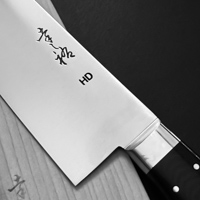
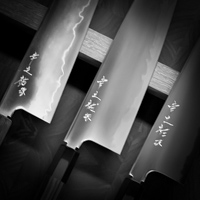
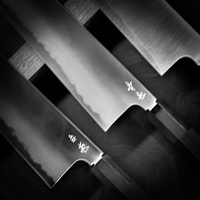
& PROTOTYPES
ENGLISH MARKINGS (Coming Soon)
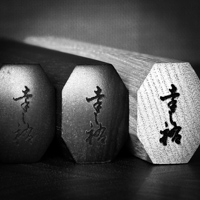
MARKINGS
Closing Notes
If there is one consistent truth about Konosuke markings, it is variability.
Across the many knife lines Konosuke has produced, the variation in stamps, chiseled kanji, placement, and combinations is remarkable. Patterns exist—but they are rarely absolute. Marks migrate from left face to right. Boxed stamps appear and disappear. Chiseled kanji replace stamped logos. Laser engraving enters the picture. Even within a single line, differences emerge that resist easy categorization.
That variability is part of what drew me in.
Researching these markings has been equal parts investigation and appreciation. Each knife presents a small puzzle. Each variation suggests a decision—practical, aesthetic, or historical. For a collector, this depth adds dimension to ownership. For someone new to Konosuke, however, it can feel overwhelming. What appears straightforward at first glance quickly reveals layers of nuance.
It is inevitable that exceptions exist beyond what is documented here. There are certain to be examples I have not encountered, transitional pieces I have not seen, and anomalies that challenge the patterns described in these pages. If you find them, I hope you will share them. Corrections, additions, and refinements benefit the entire community.
I consider this a living document. As new information emerges—or as older assumptions are clarified—I am more than willing to revise and update this work in the interest of accuracy.
I would welcome any offer to inspect and photograph knives, especially rare or one-off examples for addition to this guide.
A contact form is coming soon. In the mean time you can contact me on KKF (User Cardston) or on Reddit u/Exeter-Boy.
Note: Information on Konosuke MM, FT, Sanjo YS, GS+, MB, YM & Damascus knife lines are not included in the initial version of this guide and may be added later.
On the Photographs
The knives shown in this guide were photographed using practical lighting techniques designed to make the markings visible and legible. Capturing inscriptions on polished steel presents unique challenges; reflections easily obscure detail.
To address this, I used raking light sources, reflectors, and black panels positioned to create controlled reflections in the blade surface. The steel itself is not black. The dramatic contrast seen in some images results from reflected panels, not digital alteration.
Minor adjustments—color correction, white balance, contrast balancing, straightening, and dust spot removal—were performed in Lightroom. Otherwise, the images closely reflect what was achieved in-camera.
Unless otherwise noted, all photographs in this article are my own.
Credits
Thanks to the following for allowing me to use images:
marccheahmz (Reddit)
Tosho Knife Arts – Image of KT & kiridashi
Update Log
| Date | Details |
| April 2, 2026 | Initial publication |
Footnotes
- Konosuke Fujiyama; A History on KKF ↩︎
- Konosuke Fujiyama; A History on CKTG ↩︎
- Debossed marks are those that are recessed into the surface, while embossed marks sit proud of the surface. ↩︎